

The gains aren’t about speed alone; they’re about where human energy goes.
To me, the real productivity gain using AI tools comes from the ability to optimize our work, not from doing more for the sake of doing more. We need to improve our work, and the positive collateral effect will be more productive
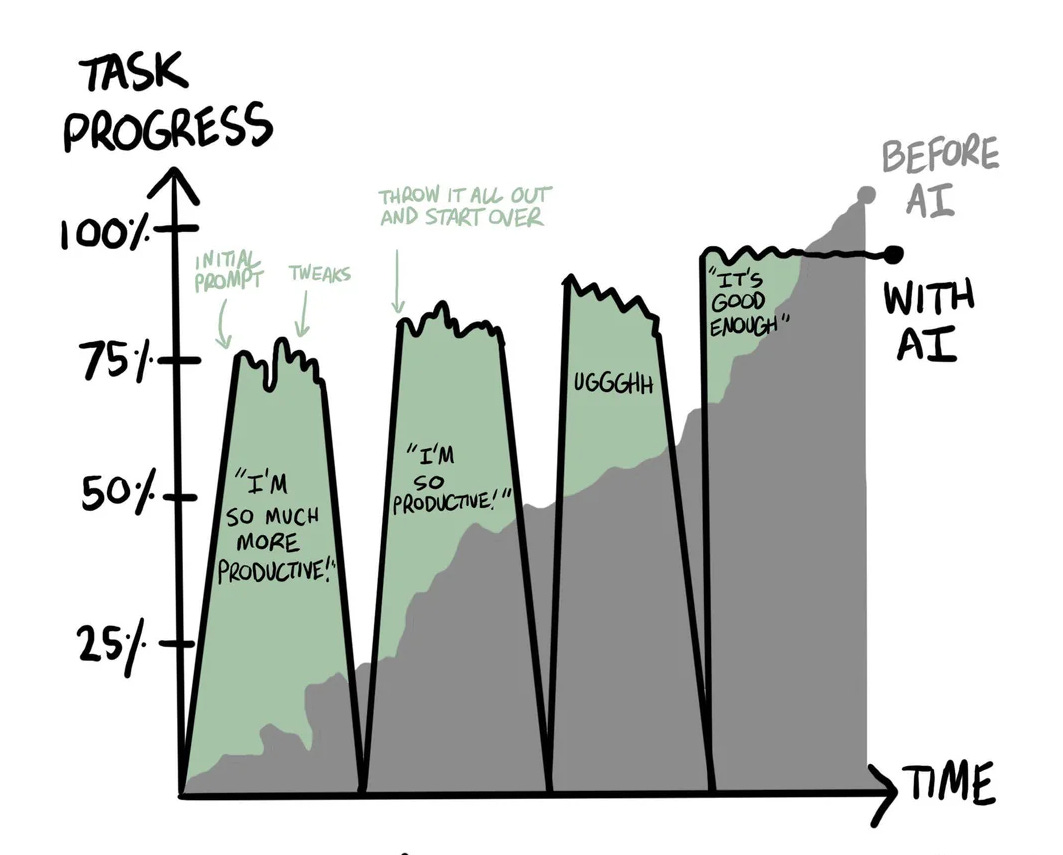
Models become better over time, and several concepts we learned months ago become less important today. And, this came as the result of weeks of personal experimentation, study, and knowledge sharing with people.
After a while of following these principles, I believe that I was able to extract much more potential from AI tools than before.
The Three Principles
Don’t try to control the AI.
The instinct when using AI is to spend 15–20 minutes crafting an instruction that tells it exactly what to do — as if correcting someone who is learning. The first shift is dropping that instinct.
Give it problems, not tasks.
Using AI “as an intern” — “make this class do X” — undersells it and overloads you. The mental model that unlocked productivity is to describe the business problem and let it decompose. Give the agent access to the stuff that matters, and the agent decides what to read, what to change, and what to test.
Extended brain, not outsourced brain.
AI can’t read your mind. Context is the activation energy. You have to tell it what the problem is, where to find things, and what constraints matter. Once that’s in, you’re genuinely co-thinking, not just delegating.
Setup Pays Off Compounding Returns
Spend some time on your setup (MCP, skills, connectors, context files), or even more, ask the agent how to configure it. The setup pays for itself in the first session.
The common pattern I’ve seen is to use AI within a single repository, in a single context, one file at a time. Don’t build this setup from scratch; it is hard, craftsman work.
Plan Mode Is Not Optional
Plan mode forces a reviewable artifact before any token is spent on possible wrong code. Spend as long as it takes to produce and refine the plan. This will save the same amount of time in mid-execution corrections. The prompt-to-execution handoff works better when you’ve spent time getting the plan right, not when you’ve rushed to give the AI a broad goal and hoped it would figure out the rest.
Code is cheaper
The cost of producing correct, tested code has dropped. What hasn’t dropped is the cost of knowing what to build and who to align with. All required human judgment.
With that team’s energy, optimally, going into decision-making, context-building, and review, not line-by-line implementation.